Outsourcing does not mean handing over your product vision and disappearing. When structured with precise governance, clear ownership boundaries, and agile operational workflows, partnering with an offshore software development agency yields greater predictability than managing an internal team from scratch.
The Core Challenge: Why Traditional Outsourcing Fails
When software outsourcing projects derail, it is rarely due to developer technical incompetence. Instead, failures stem from communication friction, opaque progress reporting, and poorly defined acceptance criteria. If an agency operates as an isolated black box—where code is submitted blindly after weeks of silence—misalignment is inevitable.
To maintain absolute control, leaders must shift from transactional outsourcing to collaborative, structured co-development models.
4 Pillars of Absolute Control When Working With an Offshore Partner
1. Complete Repository and Infrastructure Ownership
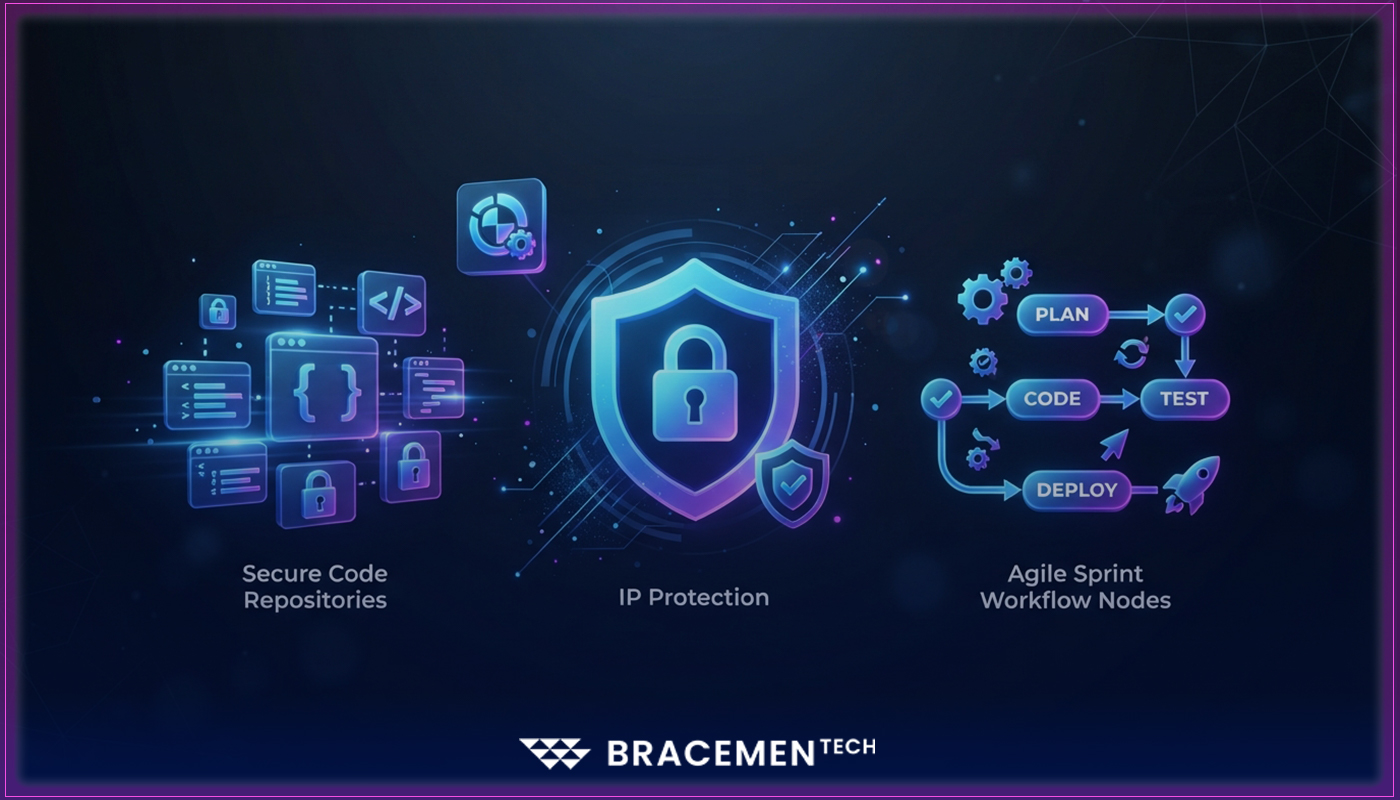
Your code should live in repositories you own (such as your company's GitHub or GitLab organization), not on a remote server controlled entirely by the vendor. Similarly, cloud infrastructure (AWS, GCP, Azure) must run on accounts owned by your business. Ensuring direct access prevents vendor lock-in and protects your digital assets.
2. Establishing Rigorous Sprint Cadences and Transparent Metrics
Control is maintained through active visibility. Insist on bi-weekly sprint reviews, functional product demos, and transparent project management boards (Jira or Linear). You should evaluate delivery capability continuously through incremental progress rather than waiting for a single, high-stakes final launch.
3. Securing Intellectual Property and Data Compliance (NDAs & Work-for-Hire)
Before exchanging a single line of functional code specifications, a binding Non-Disclosure Agreement (NDA) must be executed. Furthermore, contracts must explicitly state that all developed work is 'work-for-hire,' ensuring 100% intellectual property assignment to your business upon delivery.
4. Shifting from 'Task-Takers' to Strategic Engineering Partners
Low-cost outsourcing agencies simply execute raw instructions without questioning flawed requirements. A true engineering partner acts as a consultative advisor—challenging assumptions, recommending scalable technology stacks (such as React, Node.js, and Python), and protecting your long-term product roadmap.
How BraceMen Tech Solves the Offshore Trust Gap
At BraceMen Tech, we eliminate the friction of traditional outsourcing. We operate as an extension of your internal team—combining rigorous enterprise engineering practices with transparent sprint visibility, absolute client code ownership, and full-funnel digital alignment.
Ready to Scale Your Engineering Team Safely?
Stop risking your roadmap on opaque outsourcing models. Partner with an elite engineering team built on transparency, technical excellence, and founder-centric execution.