Selecting a proven, battle-tested technology stack ensures your SaaS Minimum Viable Product (MVP) delivers lightning-fast user experiences, secure multi-tenant capabilities, and seamless scalability from your first user to your hundred-thousandth enterprise client.
Why Your Tech Stack Choice Determines Your Startup’s Survival
Many early-stage founders make the mistake of chasing the newest, trendiest programming languages or frameworks just because they are popular on social media. Unfortunately, bleeding-edge tech often comes with unstable libraries, scarce documentation, and small talent pools.
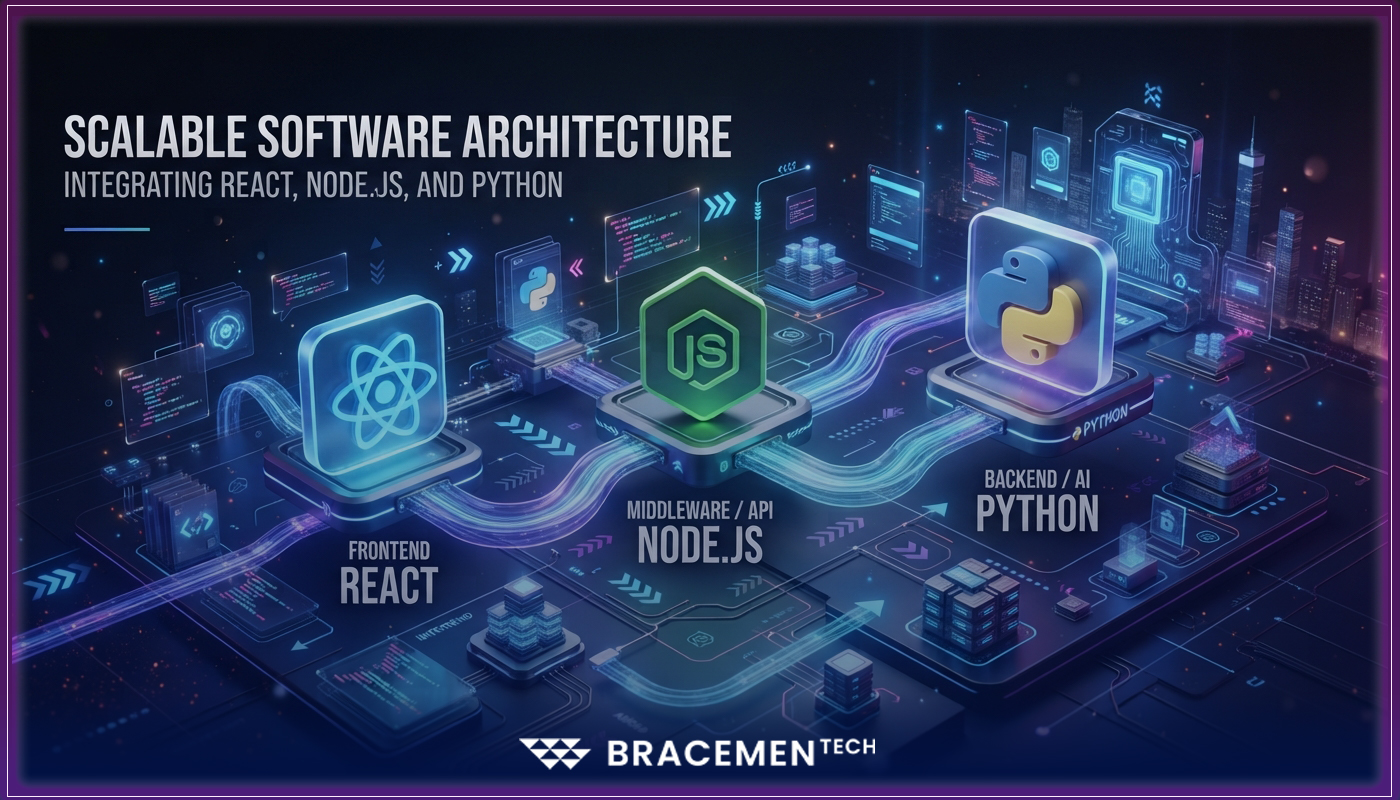
A mature, enterprise-grade technology stack like React, Node.js, and Python provides stability, extensive third-party integrations, and immediate access to global engineering talent.
Frontend Architecture: React vs. Next.js for Modern SaaS Dashboards
The frontend of your SaaS application is what your users interact with every day. Performance, responsiveness, and component reusability dictate whether users stay engaged or churn due to sluggish load times.
1. Why React Remains the Gold Standard for Component Scalability
React powers millions of enterprise applications worldwide due to its component-based architecture and virtual DOM efficiency. It allows engineering teams to build modular, reusable UI elements that speed up development velocity and maintain consistent design integrity across complex dashboards.
2. When to Choose Next.js for SEO and Server-Side Rendering
While single-page React apps are exceptional for interactive dashboards, public-facing marketing pages and content-heavy portals benefit immensely from Next.js. By utilizing Server-Side Rendering (SSR) and Static Site Generation (SSG), Next.js ensures lightning-fast page speeds and pristine indexability for search engine crawlers.
Backend Powerhouses: Node.js vs. Python for Enterprise Workflows
Behind every great user interface lies a powerful backend engine handling data processing, authentication, API integrations, and business logic.
1. Node.js: Asynchronous Speed and Real-Time Data Handling
Node.js enables developers to use JavaScript across both the frontend and backend, streamlining code maintenance and team collaboration. Its asynchronous, non-blocking architecture makes it ideal for real-time applications such as collaborative workspaces, live chat modules, and high-throughput API endpoints.
2. Python: Unmatched Power for Data Processing, AI, and Complex APIs
When your SaaS platform requires heavy data analytics, machine learning pipelines, or complex computational processing, Python (utilizing robust frameworks like Django or FastAPI) is the undisputed industry leader. It offers unmatched readability and deep integration libraries for modern AI workflows.
Avoiding Over-Engineering: Building a Lean, Maintainable MVP
A common trap for technical founders is over-engineering—building microservices architectures for a product that hasn't achieved product-market fit yet. The most successful startups start with a clean, monolithic or modular service structure using React and Node.js or Python, scaling into distributed cloud infrastructure only when user volume demands it.
Engineer Your SaaS Platform for Scale with BraceMen Tech
At BraceMen Tech, we help international founders design and engineer robust, future-proof software architectures. Whether you are building a React-powered frontend or a high-performance Python backend, our engineering teams deliver scalable code built to convert.
Ready to Build a High-Performance SaaS Product?
Stop guessing your technology roadmap. Partner with expert software architects who turn complex requirements into high-performing digital products.