For early-stage engineering teams and technical founders, few choices carry higher long-term financial consequences than choosing a backend software architecture. Walk into any technical forum or engineering conference, and you will hear conflicting paradigms. On one side, tech advocates insist that microservices are the only way to achieve modern enterprise scale. On the other, seasoned software architects warn that distributed systems too early will drain your startup's capital and stall your engineering roadmap.
Too many startup CTOs fall into the trap of over-engineering from day one. Driven by fears of future scaling bottlenecks, they construct a complex microservices mesh for a product that hasn't achieved product-market fit yet. The result? Endless DevOps overhead, fragile API contracts, and a sluggish development velocity that kills startups long before they ever reach scale.
To build a high-performance B2B SaaS platform, you must look past tech hype and understand when to deploy a modular monolith versus when microservices are genuinely justified.
The Hype vs. Reality of Early-Stage Software Architecture
The microservices revolution was pioneered by tech giants like Netflix, Amazon, and Uber. These companies operated with thousands of autonomous software engineers working on massive global infrastructures. For their organizational scale, breaking applications into hundreds of independently deployable microservices was essential to prevent developer collisions.
However, early-stage SaaS companies face completely different constraints. Early on, your primary competitive advantages are speed of iteration, product flexibility, and capital efficiency. When you adopt microservices prematurely, you swap business agility for distributed operational complexity.
The Hidden Tax of Premature Microservices Architecture
Implementing a distributed system with a team of three to ten developers introduces severe engineering friction across multiple layers:
1. Distributed Data Integrity and Transaction Management
In a traditional or modular monolithic application, maintaining data consistency is handled cleanly by relational database transactions (ACID guarantees). When a customer upgrades their SaaS subscription, your database can update the billing status, modify user permissions, and emit an audit log in a single, atomic operation.
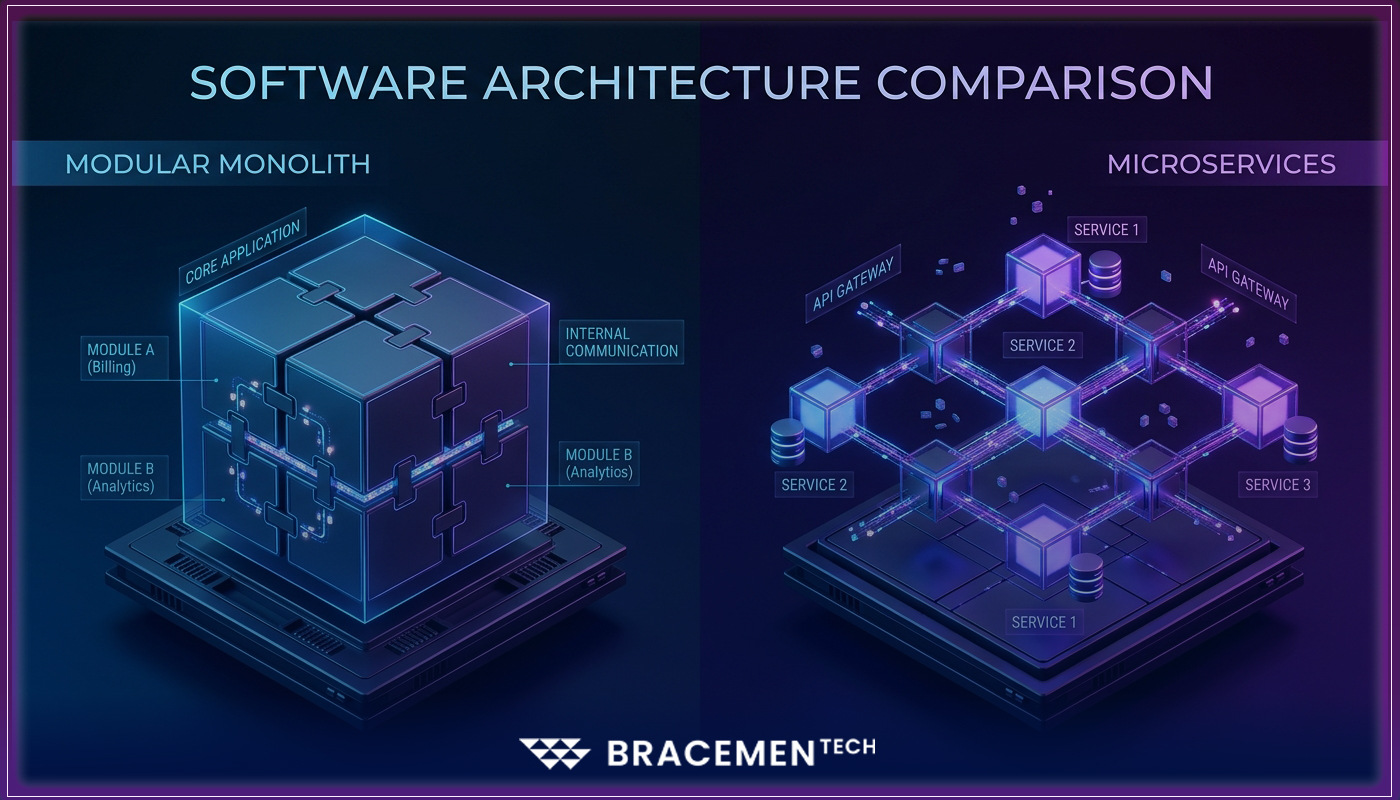
In a microservices architecture, every service owns its isolated database. Enforcing transactional consistency across a Billing Service, User Service, and Provisioning Service requires complex distributed patterns like the Saga Pattern or Two-Phase Commits (2PC). If a payment processing service succeeds but the authorization service fails mid-request, your engineering team must write custom compensating transactions to manually roll back state, consuming hundreds of engineering hours.
2. Network Latency, Serialization, and Cascading Failures
In-process function calls inside a monolithic codebase complete in nanoseconds. In a microservices architecture, every service boundary requires a network hop over HTTP/REST or gRPC. A single user request hitting your API gateway might trigger ten downstream inter-service network requests.
This introduces significant network latency, CPU serialization overhead, and the risk of cascading failures. If one downstream notification service experiences a minor delay or memory spike, it can exhaust thread pools across your entire system, crashing your user-facing application unless you implement complex circuit breakers and retries.
3. Massive DevOps and Infrastructure Overhead
A single application is straightforward to containerize, test, and deploy. Microservices, by contrast, require a sophisticated infrastructure stack:
- Kubernetes cluster management and service mesh configuration (Istio or Linkerd).
- Distributed tracing platforms (Jaeger or Zipkin) to debug multi-service request flows.
- Centralized secret management, cross-service authentication, and network security rules.
- Multiple distinct CI/CD deployment pipelines that must be maintained and monitored individually.
For early-stage startups, infrastructure costs can spike by 30% to 50% before landing a hundred paying accounts, diverting focus away from product development.
Why the Modular Monolith is the Superior Standard for SaaS
The pragmatic alternative adopted by elite engineering organizations is the modular monolith. A modular monolith combines the operational simplicity of a single deployable application with strict internal architectural boundaries.
1. Strict Domain-Driven Design (DDD) with In-Memory Performance
Within a modular monolith, the codebase is strictly segregated into independent domain modules (such as Billing, Auth, Analytics, and Notifications). Each module encapsulates its internal logic and data contracts. However, because all modules run within a single process, communication happens via fast, in-memory function calls rather than expensive network calls.
2. Simplified Multi-Tenancy and Database Pooling
B2B SaaS platforms rely heavily on secure multi-tenancy models. Managing database connections, tenant isolation rules, and schema migrations across a single PostgreSQL database is clean and cost-effective. A modular monolith allows you to enforce tenant isolation at the query level or via schema-per-tenant patterns without juggling dozens of distributed database instances.
3. Frictionless CI/CD and Unified Telemetry
A modular monolith deploys through a single, automated deployment pipeline. Testing the full system requires running local unit and integration test suites without mocking complex external networks. Centralized logging and APM tracing (using tools like Datadog or OpenTelemetry) give your team immediate visibility into application bottlenecks.
How to Architect a High-Performance Modular Monolith
To prevent a monolith from deteriorating into a messy "Big Ball of Mud," your team must follow three fundamental engineering rules from day one:
Step 1: Establish Explicit Bounded Contexts
Use Domain-Driven Design (DDD) principles to define clear boundaries. The Billing module should never directly read or alter tables belonging to the User Management module. Every module must own its logical database tables.
Step 2: Enforce Strictly Encapsulated Module APIs
Modules should only interact through public interface contracts. If the Analytics module needs user data, it must request it through an exposed public service method provided by the User module—never by executing raw SQL joins across database schemas.
Step 3: Implement Asynchronous Event Bus Messaging
For decoupled operations (such as sending a welcome email or updating a search index after a user registers), use an internal event bus. The User module publishes a UserRegisteredEvent, and subscriber modules consume the event asynchronously without blocking the primary request thread.
The Decision Matrix: When Should You Actually Extract Microservices?
You should not stay in a monolith forever, nor should you start in microservices. The decision to extract a service should be driven by measurable operational triggers:
Trigger 1: Asymmetric Resource Consumption Demands
If your SaaS platform processes heavy background background tasks—such as AI video generation, complex PDF rendering, or large data exports—that consume 90% of CPU/RAM, running those tasks inside your core Web monolith can degrade HTTP request performance. Extracting that specific domain into an isolated worker service allows you to scale it independently.
Trigger 2: Team Boundary Conflicts and Release Bottlenecks
When your engineering team grows past 20 to 30 developers across multiple domain squads (e.g., Payments Team, Core Platform Team), managing a single shared deployment queue can slow release cycles. Extracting clear bounded contexts into dedicated microservices allows separate engineering teams to deploy independently.
Trigger 3: Specialized Security and Compliance Isolation
If a specific component requires strict PCI-DSS payment compliance or HIPAA health data handling, isolating that logic into a hardened service reduces your compliance audit scope across the rest of the application.
The Strangler Fig Pattern: Migrating Without Rewriting Everything
If your SaaS platform eventually reaches the scale where microservices are necessary, do not attempt a risky "ground-up rewrite". Instead, utilize the Strangler Fig Pattern:
- Keep your core modular monolith running as the primary system.
- Select a single, highly isolated domain module with clear boundaries (e.g., Notifications).
- Build the new standalone Microservice alongside the existing system.
- Update your API Gateway to route traffic for that specific domain to the new service while leaving all other traffic directed to the monolith.
- Decommission the old internal module inside the monolith once the microservice proves stable in production.
Engineer Scalable Software Architecture with BraceMen Tech
At BraceMen Tech, we help technical founders and growth-stage companies design resilient, future-proof software backends tailored to their exact scale. Whether you are architecting an initial SaaS MVP or breaking down a monolith into targeted microservices, our engineering teams deliver maintainable code built to scale across US, UK, and GCC markets.
Ready to Future-Proof Your SaaS Codebase?
Stop letting architectural friction slow down your product roadmap. Partner with software architects who build for performance, agility, and long-term maintainability.
>>> Book a Technical Architecture Consultation with BraceMen Tech Today